Modern Interior Design
Modern design strips a room down to what matters: clean geometry, honest materials, and breathing room. The result feels calm, deliberate, and quietly confident.


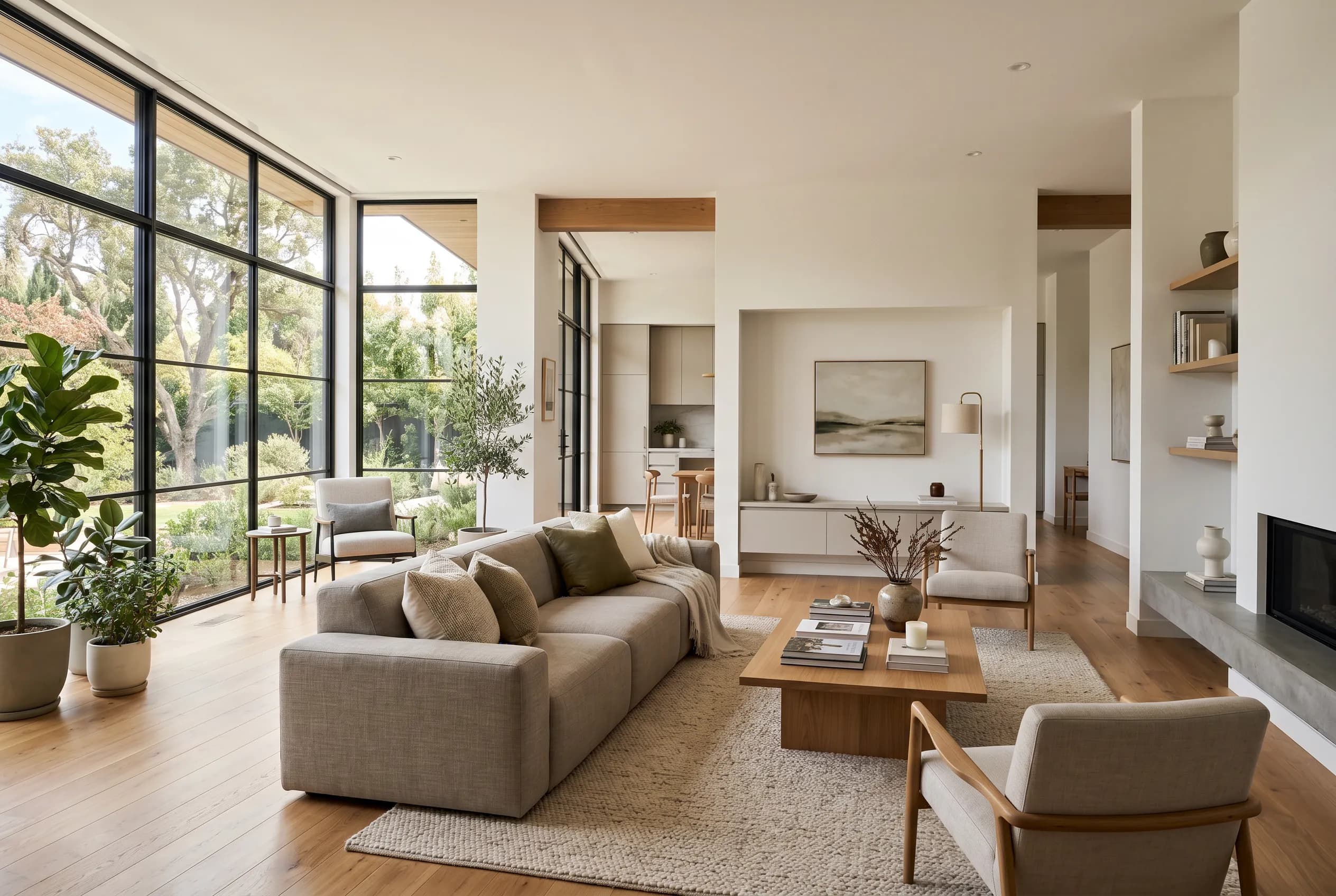
Modern is a precise design language built on restraint. It favors flat planes over ornament, straight or gently curved lines over fuss, and a tight palette anchored in neutrals. Form follows function here, so every piece earns its place, and the empty space between objects is treated as part of the composition.
Living in a Modern room feels uncluttered without feeling cold, especially when warm woods and soft textiles soften the hard edges. The look suits people who want a home that reads as intentional rather than busy, and it works beautifully in spaces with good natural light, open floor plans, or strong architectural bones worth showing off.
Modern design grew out of the early-20th-century reaction against Victorian excess, crystallizing at the Bauhaus school founded by Walter Gropius in Weimar in 1919. Its principles spread through figures like Le Corbusier and Ludwig Mies van der Rohe, whose phrase "less is more" became shorthand for the whole movement. New industrial materials made it possible: tubular steel, plate glass, and reinforced concrete let designers build the clean, load-bearing simplicity that still defines the style.
What Defines Modern Design
Clean, uninterrupted lines
Furniture and architecture lean on straight edges and simple geometry. Profiles stay low and horizontal, and silhouettes read clearly against the wall.
Function over ornament
Decoration for its own sake is removed. A piece justifies itself by use, so surfaces stay flat and detailing stays minimal.
Neutral base, controlled contrast
Walls and large pieces sit in white, gray, or warm beige, with black or a single saturated accent used sparingly for punctuation.
Open, considered space
Negative space is intentional. Rooms avoid crowding, letting a few strong pieces stand on their own.
Honest, natural materials
Wood grain, stone, metal, and glass appear as themselves rather than disguised, celebrating the material's true texture.
Abundant natural light
Large windows and unfussy treatments keep daylight moving through the room and bounce it off pale surfaces.
Modern Color Palette
Soft White
#F4F2ED
Warm Greige
#C9C2B6
Slate Gray
#7A7D80
Walnut Brown
#5C4533
Graphite Black
#1C1C1C
Signature Materials
- Light and walnut wood veneers
- Brushed and polished stainless steel
- Clear and frosted glass
- Honed concrete
- Natural stone and quartz
- Powder-coated metal
- Leather upholstery
- Low-pile wool textiles
Pieces That Define It
- Low-profile platform sofa
- Tulip or pedestal dining table
- Cantilevered or molded shell chairs
- Floating media console
- Sculptural floor lamp with a slim arm
- Large-format abstract artwork
- Geometric area rug in a muted tone
Get a Modern Room in Seconds
With InteriorLab, getting the Modern look starts with a single photo of your room or a quick LiDAR scan. Pick Modern from the 19 styles and the AI redesigns the space in seconds, swapping in clean-lined furniture, a neutral palette, and an open layout that respects your existing walls and windows. From there you can refine: highlight a busy sofa and replace it with a low-profile one, recolor a wall to soft white, or Magic Erase clutter that breaks the calm. When a piece works, Shop the Room links many items to products you can actually buy, and Furniture Fit lets you preview a real chair or table in AR before you commit.
Tips for Nailing the Modern Look
Edit before you add
Modern rooms succeed by subtraction. Clear surfaces, hide cords, and keep only the pieces that serve a purpose, then judge whether the room still needs more. Most of the time it doesn't.
Warm the neutrals
An all-gray scheme can drift cold. Bring in a walnut table, a leather chair, or a wool throw so the warm tones balance the hard, flat surfaces and the space feels lived-in.
Let one thing be the moment
Choose a single statement piece, a sculptural light, a bold artwork, a deep accent color, and keep everything around it quiet. Modern reads best when contrast is deliberate, not scattered.
Best Rooms for Modern Style
Modern Design FAQs
What is the difference between modern and contemporary design?
Modern refers to a specific historical movement rooted in early-to-mid-20th-century design and the Bauhaus, with a fixed set of principles. Contemporary describes whatever is current right now, so it shifts over time and borrows freely. A modern room is a defined look; a contemporary one is a moving target.
Does modern design have to feel cold or sterile?
No, and the best modern rooms aren't. Coldness comes from leaning too hard on gray, glass, and metal. Layer in warm wood tones, leather, wool, and a little greenery, and the same clean lines read as calm and inviting instead of clinical.
What colors define a modern interior?
The foundation is neutral: white, warm greige, and gray across walls and large furniture. Black is used as a graphic outline on frames, legs, and fixtures. A single saturated accent, such as a deep blue, rust, or olive, can appear in small doses for contrast without breaking the restraint.
Does modern design work in an older or traditional home?
Yes, and the contrast can be striking. Modern furniture set against original moldings, brick, or beams plays the clean new pieces off the architecture's history. The key is to commit to a few strong modern elements rather than half-measures, so the two eras read as a deliberate conversation.
Explore related styles
Design your space in Modern style
Download InteriorLab free and redesign any room with AI in seconds.