AI Open-Plan Space Design
One big room doing three jobs at once. An open-plan space rewards good zoning and a single material thread, and InteriorLab can test both before you move a thing.


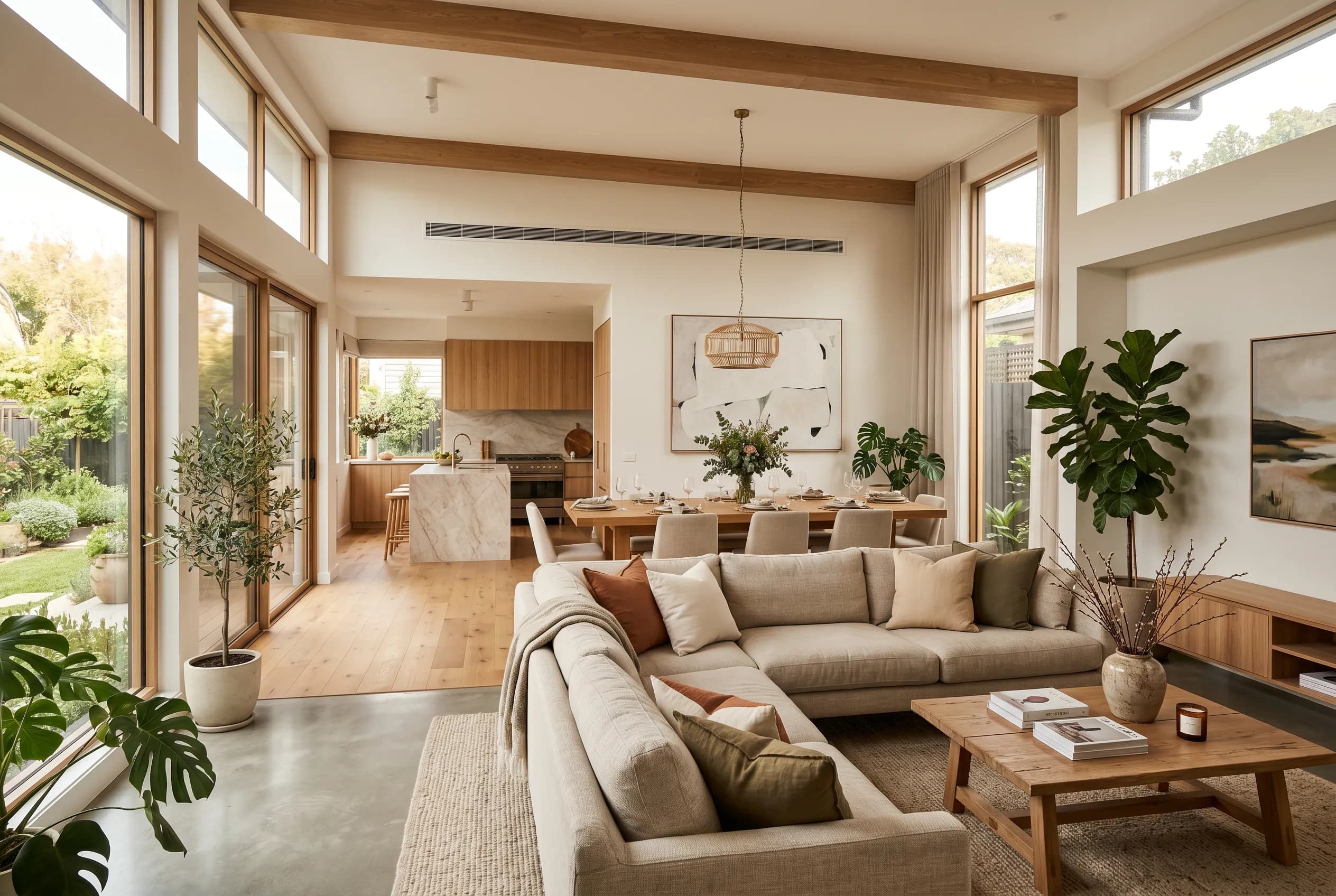
The open-plan layout grew out of mid-century thinking, when architects like Frank Lloyd Wright tore down the walls between kitchen, dining, and living to let light and conversation flow. Today it is the default in new builds and loft conversions, and the appeal is obvious: a brighter, more sociable home where the cook is never cut off from the room. The catch is that one undivided space has to carry several functions without turning into a furniture warehouse.
Designing an open-plan area is really about reading the room as connected zones rather than one flat field. A rug anchors the seating, a run of pendants marks the dining table, the back of a sofa quietly draws the line where the living area ends. Sightlines matter more here than in any closed room, because you see everything at once. The trick is enough visual variety to define each function, held together by a consistent palette and one or two repeating materials so the whole reads as a single space.
Common Open-Plan Space Design Challenges
Defining zones without walls
Kitchen, dining, and lounge all share one volume, so you have to separate them with rugs, lighting, and furniture placement instead of partitions. Get it wrong and the room feels like a showroom floor.
Keeping a coherent look
Three functions can pull toward three different styles. A consistent palette and a couple of repeating materials are what stop an open-plan space from looking like several rooms crammed together.
Managing noise and clutter
Hard surfaces and an open volume bounce sound, and a messy kitchen is on permanent display. Soft textiles, closed storage, and a tidy backdrop behind the cooking zone do a lot of quiet work.
Anchoring the furniture
With no walls to push against, large pieces can drift and float. Furniture often needs to be arranged in the middle of the room, backs facing each other, to give each zone a clear edge.
Redesign Your Open-Plan Space With AI
Open InteriorLab, snap a photo of your open-plan space or LiDAR-scan it, and pick from 19 styles to see the whole volume redesigned in seconds, with kitchen, dining, and lounge reading as one room. Use Rearrange to test new layouts and find where the sofa and table should sit to define each zone, without buying anything. Highlight a single element, like an island stool, a rug, or a pendant run, to swap, recolor, or remove it with Magic Erase, then place a real sofa or dining set in your room with Furniture Fit in AR before you commit. Shop the Room links many of the pieces to products you can actually buy, and the Budget Planner finds combinations that furnish all three zones within a set figure.
Open-Plan Space Design Tips
Draw the zones with rugs and light
Give the seating area its own rug large enough that the front furniture legs sit on it, and hang a run of pendants directly over the dining table. These two moves alone tell the eye where one zone ends and the next begins, no wall required.
Repeat one material across the room
Carry a single timber, metal, or stone through the kitchen, dining, and living zones so they read as one space. Oak that appears on the floor, the island, and a side table stitches the whole room together far better than three matching style choices.
Float the sofa to make a wall
Pull the sofa away from the perimeter and turn its back to the kitchen. That back becomes the soft divider between cooking and lounging, and a console table behind it adds storage and a landing spot without closing the room in.
Best Styles for a Open-Plan Space
Open-Plan Space Design FAQs
How do I separate the kitchen from the living area in an open-plan space?
You separate by suggestion, not by walls. A kitchen island or peninsula creates a natural boundary, the back of a sofa marks where the lounge begins, and a change of flooring or a rug signals the shift. In InteriorLab you can use Rearrange to test where each piece sits before moving anything.
What flooring works best in an open-plan room?
One continuous floor run across the whole space is usually best, because changing materials at every zone chops the room up and makes it feel smaller. A single wood or large-format tile keeps things calm and open, and you then use rugs on top to define the seating and dining areas.
How do I stop an open-plan space from feeling like one big empty room?
Vary the height and density of furniture so the eye has things to land on, and break the floor into zones with rugs and lighting. A low coffee table, a tall plant, and pendants over the table all add layers. Repeating a single palette and material keeps that variety from tipping into chaos.
Can InteriorLab redesign my whole open-plan layout at once?
Yes. Snap or scan the space and the AI redesigns the full volume, treating the kitchen, dining, and living zones as one connected room rather than separate shots. Use Rearrange to try new layouts and Furniture Fit to preview real pieces in AR before you buy.
Redesign another room
Redesign your open-plan space today
Download InteriorLab free and see your new space in seconds with AI.