Maximalist Interior Design
More is more, and done well it sings. Maximalist rooms pile on saturated color, layered pattern, and a lifetime of collected objects until the whole space feels personal, abundant, and alive.


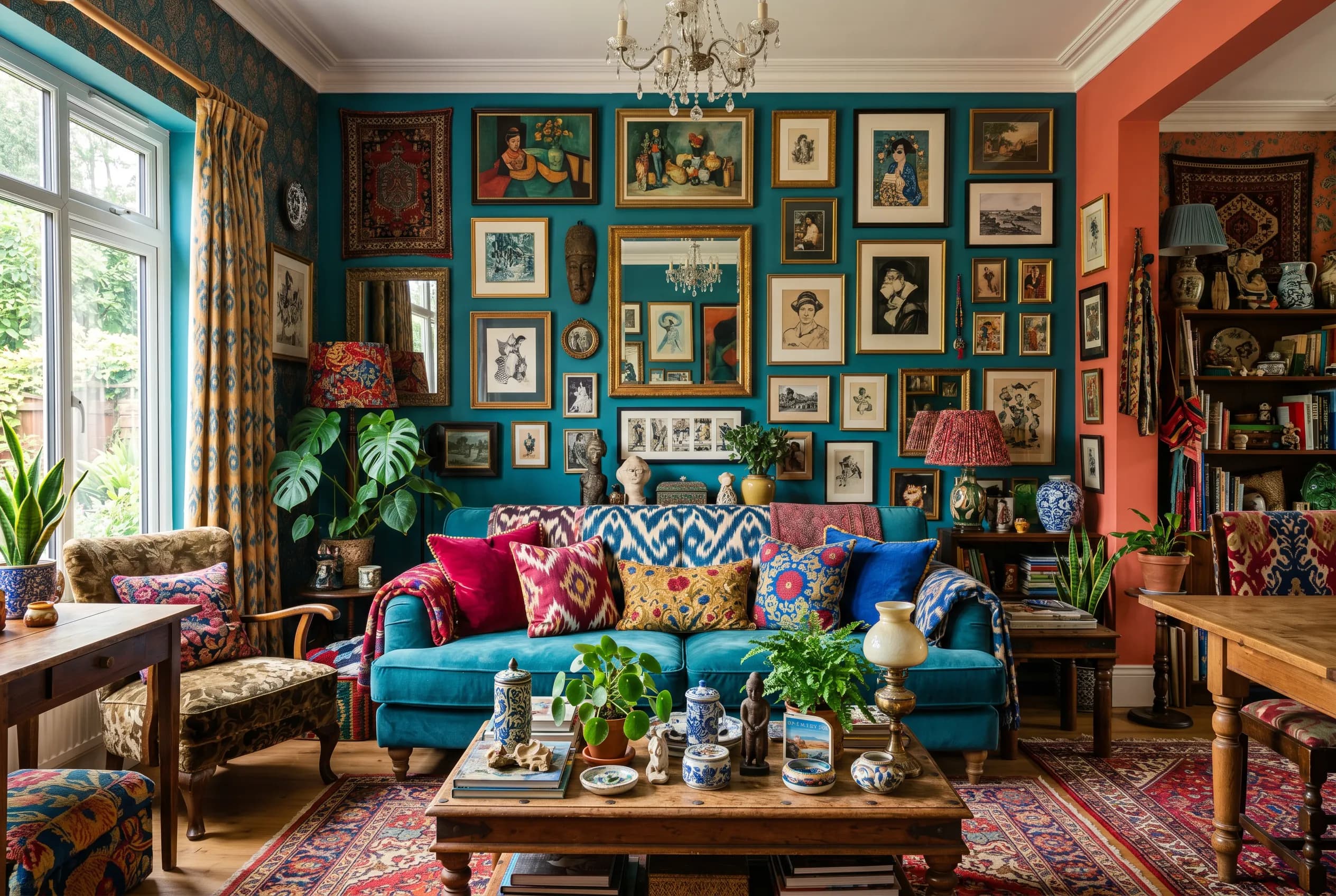
Maximalism is the deliberate embrace of abundance: rich color, clashing-but-considered pattern, and surfaces full of things that mean something. Where minimalism strips a room to its essentials, maximalism builds it up in layers, mixing eras, textures, and origins so the eye always has somewhere to land. The trick is that it only looks careless. Behind a good maximalist room sits real discipline about repeated color, balanced visual weight, and a point of view that ties the chaos together.
Living in a maximalist room is immersive rather than restful, and that is the point. The walls tell you who lives there, the shelves hold travels and inheritances, and there is no anxiety about an empty surface. It rewards people who collect, who love color, and who would rather a room feel like a story than a showroom. It works best in rooms you linger in, where there is time to notice the third and fourth detail.
Maximalism has deep roots in the layered interiors of Victorian and Renaissance Europe, where wealth was displayed through pattern, gilding, and densely hung walls. Its modern revival owes a lot to mid-century decorators like Dorothy Draper, whose oversized florals and high-contrast color rejected austerity outright, and later to designers like Tony Duquette and Iris Apfel, who made flamboyant excess a celebrated personal language. The current wave is a direct reaction against the gray, pared-back interiors of the 2010s, a swing back toward color, craft, and rooms that look lived in.
What Defines Maximalist Design
Saturated, fearless color
Deep jewel tones, emerald, sapphire, and oxblood, often go on walls and ceilings, not just accents. Color is the structure of the room, not a finishing touch.
Layered pattern
Florals meet stripes meet animal print, held together by a shared color or a consistent scale. Mixing many patterns, rather than matching, is the whole game.
Collected, curated objects
Art, books, ceramics, and travel finds cover surfaces and walls. Nothing is bare, and most things have a story attached.
Gallery and salon-style walls
Art hangs floor to ceiling, frames touching, mixing styles and sizes. Empty wall is treated as wasted opportunity.
Rich, tactile texture
Velvet, brass, lacquer, and patterned tile pile up to keep the eye moving. The surface variety is what makes the density feel luxurious rather than busy.
Bold pattern repetition
A single motif or color repeated across the room, in a rug, a lampshade, a cushion, is what stops the layering from tipping into clutter.
Maximalist Color Palette
Emerald Green
#1F6B4A
Sapphire Blue
#1E3A5F
Oxblood
#6E2436
Mustard Gold
#C9962E
Fuchsia Pink
#B23A77
Signature Materials
- Jewel-tone velvet
- Polished brass and gold
- Patterned and encaustic tile
- High-gloss lacquer
- Botanical and damask wallpaper
- Persian and kilim rugs
- Marble with heavy veining
- Fringed and tasseled textiles
Pieces That Define It
- Velvet sofa in emerald or jewel-tone upholstery
- Salon-style gallery wall of mismatched frames
- Patterned statement wallpaper or painted ceiling
- Brass-and-glass display cabinet packed with objects
- Layered area rugs with clashing patterns
- Oversized table lamp with a printed shade
- Shelves crowded with books, ceramics, and curios
Get a Maximalist Room in Seconds
With InteriorLab, building a maximalist room starts with one photo of your space, or a LiDAR scan if your device supports it. Choose Maximalist from the 19 styles and the AI restyles the whole room in seconds, layering in saturated color, mixed pattern, and a wall of art while keeping your real layout intact. From there you refine piece by piece: highlight a plain sofa to recolor it emerald velvet, swap a bare wall for botanical wallpaper, or Magic Erase one element when a corner gets too loud. When the mix feels right, use Furniture Fit to preview a bold statement piece in AR before buying, and Shop the Room to track down the real rugs, lamps, and cabinets behind the look.
Tips for Nailing the Maximalist Look
Anchor the chaos with a repeated color
Pick two or three colors and make sure each appears at least three times around the room, in a cushion, a frame, a lampshade. That repetition is the invisible thread that turns a busy room into a deliberate one.
Vary the scale of your patterns
Pair a large floral with a fine stripe and a medium geometric rather than three patterns of the same size. Mixing scale lets the eye separate them, so layered pattern reads as rich instead of muddy.
Give the eye one place to rest
Even a maximalist room needs a quiet zone, a plain wall behind the art, a solid-color sofa, a stretch of clear floor. That single pause is what keeps abundance from sliding into clutter.
Best Rooms for Maximalist Style
Maximalist Design FAQs
Is maximalism just the opposite of minimalism?
In spirit, yes, but it is not the same as clutter. Minimalism subtracts until only essentials remain; maximalism adds in layers, but with real control over color, pattern scale, and balance. A good maximalist room is as carefully composed as a minimalist one, just in the other direction.
How do I mix patterns without the room looking messy?
Two rules carry most of the work: share a color across your patterns, and vary their scale. If a large floral, a thin stripe, and a small geometric all pull from the same palette, the eye reads them as a family rather than a fight.
Can maximalism work in a small room?
Yes, and small rooms can actually suit it. A powder room or study is the perfect place to go all in on bold wallpaper and dense art, since the scale is contained. Dark, saturated walls can even make a small space feel cocooning and intentional rather than cramped.
Will a maximalist interior date quickly?
Less than you might expect, because it is built from personal collections rather than a single trend. Since the look is rooted in things you genuinely love, art, books, inherited pieces, it tends to evolve with you instead of expiring on a season's schedule.
Explore related styles
Design your space in Maximalist style
Download InteriorLab free and redesign any room with AI in seconds.