Art Deco Interior Design
Art Deco trades restraint for confidence: sunburst patterns, polished brass, and deep jewel tones arranged with strict symmetry. It is the look of a room that wants to be admired.


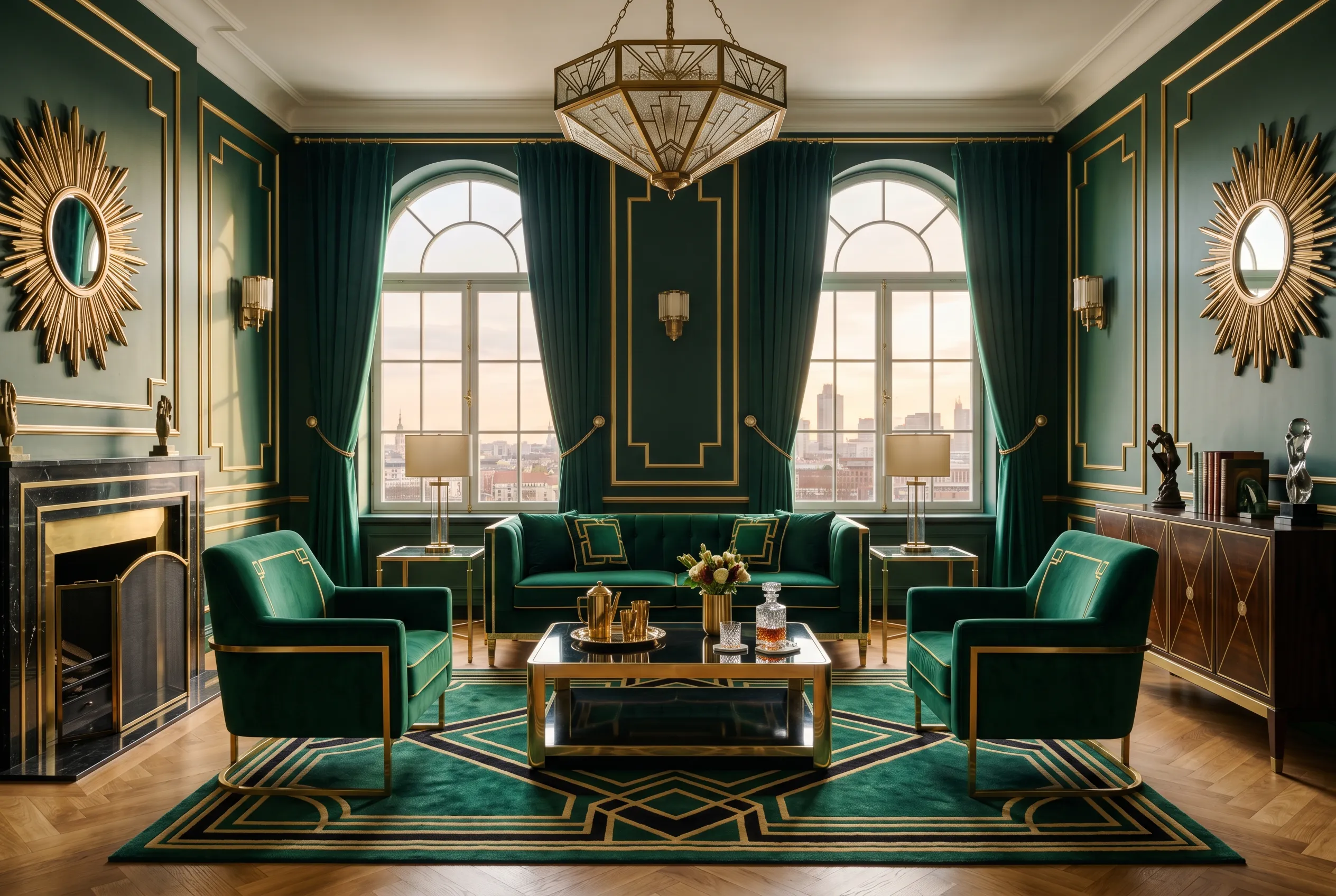
Art Deco is a decorative style built on geometry and gloss. Think stepped silhouettes, chevrons and sunbursts, fan motifs, and strong vertical lines, all balanced by symmetry and rich, reflective surfaces. Color runs bold and saturated, often paired with black, gilt, and mirror. Where minimalism strips things back, Art Deco layers them up with intent.
Living with Art Deco feels theatrical in the best way. A small entry hall, a powder room, or a cocktail corner can carry the whole drama without overwhelming a home. It rewards rooms with good ceiling height and a bit of natural light to catch the metallics, and it works best when you let one or two statement pieces lead and keep the supporting cast disciplined.
Art Deco took its name from the 1925 Exposition Internationale des Arts Decoratifs et Industriels Modernes in Paris, where the style was first showcased to the world. It spread through the 1920s and 1930s across architecture, ocean liners, and cinema palaces, absorbing influences from ancient Egypt after the 1922 Tutankhamun discovery, Cubism, and the machine age. New York landmarks like the Chrysler Building remain its most quoted reference.
What Defines Art Deco Design
Bold geometry
Sunbursts, chevrons, zigzags, and stepped ziggurat shapes appear everywhere, from inlaid floors to mirror frames. The patterns are crisp and repeating, never organic.
Strong symmetry
Furniture and decor are arranged in mirrored pairs, with a clear central axis. The balance reads as deliberate and a little ceremonial.
High-shine surfaces
Lacquer, polished brass, chrome, and mirror reflect light around the room. The glossiness is part of the glamour, not a finish to be softened.
Saturated color
Deep emerald, sapphire, oxblood, and black anchor the palette, lifted by gold and the occasional flash of coral or jade.
Luxe materials
Exotic veneers, marble, velvet, and shagreen signal craft and expense. Texture does a lot of the heavy lifting.
Vertical emphasis
Tall mirrors, fluted columns, and stepped forms draw the eye upward, echoing the skyscraper aesthetic the style grew up alongside.
Art Deco Color Palette
Emerald Green
#0B6E4F
Onyx Black
#1A1A1A
Antique Gold
#C5A253
Sapphire Blue
#1B3A6B
Oxblood Red
#6E1F2B
Signature Materials
- Polished brass and chrome
- Black and white marble
- High-gloss lacquer
- Mirror and beveled glass
- Velvet upholstery
- Exotic wood veneer (walnut, ebony, zebrawood)
- Shagreen and lacquered hide
- Mother-of-pearl inlay
Pieces That Define It
- Sunburst or starburst mirror
- Fluted or scalloped bar cabinet
- Curved velvet club chair
- Stepped or skyscraper-form sideboard
- Geometric area rug with chevron motif
- Frosted-glass and brass globe pendant
- Mirrored cocktail table
Get a Art Deco Room in Seconds
Snap a photo of your room, or scan it with LiDAR, and pick Art Deco from InteriorLab's 19 styles to see your space reimagined with geometric patterns, brass accents, and deep jewel tones in seconds. From there you can refine: highlight the sofa to swap it for a curved velvet club chair, recolor a wall to emerald or oxblood, or use Magic Erase to clear clutter that breaks the symmetry. Preview a sunburst mirror or bar cabinet in your actual room with Furniture Fit in AR, then use Shop the Room to buy the pieces that brought the look together.
Tips for Nailing the Art Deco Look
Let one piece lead
Art Deco can tip into costume quickly. Choose a single hero, a lacquered bar cabinet or a sunburst mirror, and keep the surrounding pieces simpler so the drama lands instead of competing with itself.
Pair metallics with depth
Brass and gold sing against dark, saturated backgrounds. Set your metallics over emerald, navy, or near-black walls rather than pale neutrals, and the whole room reads richer.
Repeat one geometric motif
Pick a single shape, the chevron, the sunburst, or the stepped fan, and echo it across a rug, a mirror frame, and a cushion. Repetition is what makes Art Deco feel composed rather than busy.
Best Rooms for Art Deco Style
Art Deco Design FAQs
What is the difference between Art Deco and Art Nouveau?
Art Nouveau came first, in the 1890s, and celebrated flowing, organic lines drawn from plants and the female form. Art Deco, which followed in the 1920s, swapped those curves for sharp geometry, symmetry, and machine-age glamour. If the motifs look like vines, it is Nouveau; if they look like sunbursts and skyscrapers, it is Deco.
Can Art Deco work in a small apartment?
Yes, and it often shines in small spaces because so much of the effect comes from finish rather than scale. Lean on mirror and lacquer to bounce light, choose one bold geometric pattern, and add a brass accent or two. A powder room or entry is a great place to go full Deco without overwhelming the home.
Which colors define the Art Deco palette?
Deep, saturated jewel tones do the heavy lifting: emerald green, sapphire blue, oxblood, and rich black. Gold and brass provide the warm metallic contrast, with occasional flashes of coral, jade, or cream. The key is high contrast, dark grounds against gleaming gilt.
Is Art Deco still in style today?
It cycles back regularly because it pairs so well with contemporary rooms. Designers borrow Deco geometry, brass, and curved velvet seating and mix them into otherwise modern interiors, a look sometimes called Hollywood Regency or modern glam. Used in moderation, it reads timeless rather than dated.
Explore related styles
Design your space in Art Deco style
Download InteriorLab free and redesign any room with AI in seconds.