10 min read
Interior Design for Men: 12 Tips for a Sharper Home
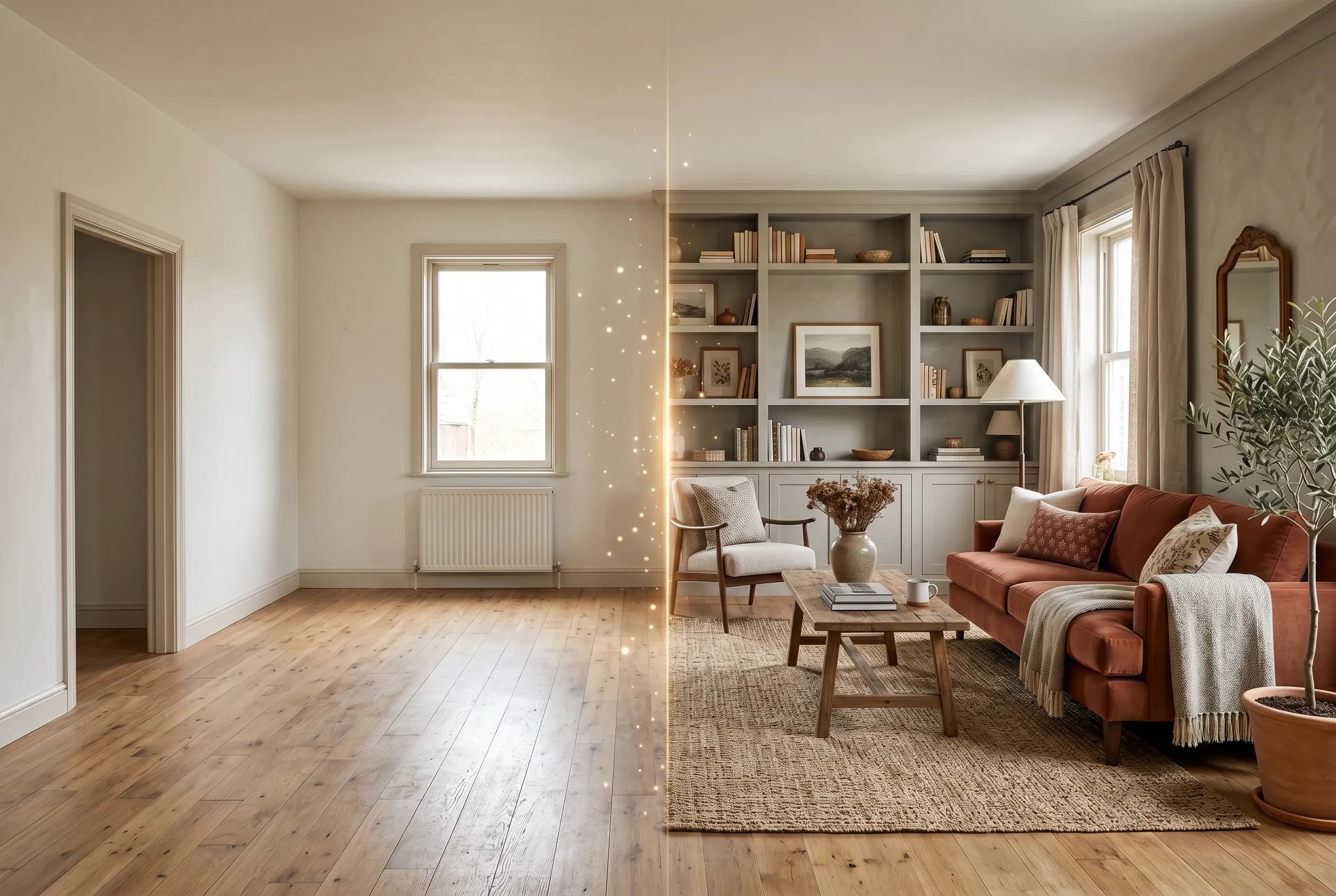
Most advice aimed at guys who want a better-looking place starts and ends with the same cliché: a black leather sofa, a neon sign, and a giant TV. That is a style, not a strategy, and it is the reason a lot of men's rooms end up feeling like a showroom for one product rather than a place to live. Good masculine design is not about a color or a single statement piece — it is about a few decisions, made on purpose, that make a room feel warm, durable, and unmistakably yours.
This is a practical guide, not a mood board. The tips below work whether you are furnishing your first apartment, finally fixing the room you have ignored for two years, or just trying to make the place look like an adult lives there. We build InteriorLab, an AI interior design app, so we will point out where it genuinely saves you time — but every tip here stands on its own, app or not.
1. Start with a palette, not a single color
The biggest myth in masculine design is that "masculine" means black, charcoal, and more black. A room built entirely on dark tones reads cold and one-note. A sophisticated palette is about contrast and warmth, not absence of color. Pick a small family of tones and let them repeat across the room — that is what makes a space look intentional instead of accidental.
A reliable starting point is the 60-30-10 rule: roughly 60 percent dominant tone (usually a neutral on walls and big furniture), 30 percent secondary (a sofa, a rug, curtains), and 10 percent accent. For 2026, the trend has moved toward warm minimalism — grounded, earthy neutrals like warm taupe, greige, and stone, paired with one deeper note. Deep burgundy, oxblood, aubergine, forest green, and navy are the standout accent colors right now because they add depth and a bit of luxury without shouting.
- Build on warm neutrals — charcoal, warm taupe, greige, stone, crisp white — not pure black.
- Add depth with one saturated accent: navy, oxblood, deep burgundy, or forest green.
- Use the 60-30-10 split so no single color takes over the room.
- Repeat each color at least twice so the palette feels deliberate, not random.
2. Buy fewer things, but buy them once
The fastest way to make a place look cheap is to fill it with cheap furniture that falls apart inside a year. The smarter move is to spend your budget on a few anchor pieces — the sofa, the bed frame, one good chair, a solid table — and let everything else be inexpensive and replaceable. Anchor pieces are the things you touch every day and look at the most, so they are worth getting right.
Look for materials that age well rather than wear out. Full-grain or top-grain leather develops character over years; solid or veneered hardwood survives moves; powder-coated steel shrugs off abuse. If a leather sofa is out of budget, "leather match" pieces put real leather only where your skin touches and cost far less. The goal is a room where the expensive-looking things are genuinely built to last, and the trend-driven things are cheap enough to swap.
- Spend on anchors: sofa, bed frame, one statement chair, a dining or coffee table.
- Choose materials that improve with age — leather, solid wood, metal, stone.
- Save on the swappable layer: pillows, throws, rugs, lamps, and art.
- Avoid the cheap-replace cycle; one good piece outlasts three flimsy ones.
3. Layer your lighting and kill the single overhead bulb
Nothing flattens a room faster than one harsh ceiling light. Even great furniture and a perfect palette look bad under a single overhead bulb. Designers solve this with three layers of light, and the difference is dramatic — good lighting makes a space feel finished and makes everything in it look more expensive.
Ambient lighting is the soft, general glow that fills the room. Task lighting is focused — a reading lamp by the bed, a desk light, under-cabinet strips in the kitchen. Accent lighting is purely about mood: a floor lamp in a corner, LED strips behind a shelf or TV, a warm bulb in a sculptural fixture. Put the big lights on a dimmer, keep color temperature warm (around 2700K), and you can take the same room from focused work mode to relaxed evening with one adjustment.
- Use three layers: ambient (general), task (focused), and accent (mood).
- Put overhead lights on a dimmer instead of relying on one bright switch.
- Stick to warm bulbs (~2700K) — cool white reads like an office.
- Add a floor lamp and a table lamp before you add anything else.
4. Get scale and layout right before you buy
Scale is where most rooms quietly go wrong. A sofa that is too big swallows a small living room; a tiny rug and a lonely chair make a large room feel unfinished. Before you buy anything, measure the room and the piece, then tape out the footprint on the floor so you can actually walk around it. Proportion — how pieces relate to each other and the space — matters more than any individual item.
If you are working with an apartment or a small space, lean on multi-functional furniture and vertical space: a storage ottoman, a wall-mounted desk, floating shelves, a bed with drawers underneath. Keep walkways clear, float furniture slightly off the walls when you can, and let a consistent neutral palette make the room read bigger. The aim is a layout that flows, not one that is crammed to the edges.
- Measure the room and the furniture, then tape the footprint on the floor first.
- Match the rug to the room — large enough for the front legs of the seating to sit on it.
- In small spaces, choose multi-functional pieces and build upward with shelves.
- Leave clear walkways; an over-furnished room always looks worse than a sparse one.
5. Mix materials so the room doesn't feel sterile
A room that is all one material — all wood, all metal, all soft upholstery — feels flat. The trick that makes masculine spaces look rich and lived-in is contrast in texture. Pair a leather sofa with a chunky wool throw; set a smooth stone or concrete surface against warm wood; add matte black metal against soft linen. The eye reads that variety as depth, and the room stops feeling like a catalog page.
Natural materials do most of the heavy lifting here. Wood, leather, stone, and metal bring warmth and a tactile quality that paint alone never will. And do not skip greenery — a couple of low-maintenance plants (a snake plant, a ZZ plant, a rubber tree) instantly soften hard lines and make a space feel alive rather than staged.
- Combine at least three materials — e.g. leather, wood, and metal — in every room.
- Contrast smooth with rough: stone or concrete against wool, linen, or boucle.
- Add one or two hardy plants to warm up clean lines.
- Use a rug to anchor the seating area and add softness underfoot.
6. Tame the clutter and hide the tech
A clean room beats a decorated one. The single most masculine thing you can do for a space is get the clutter and the cables under control, because no amount of styling survives a tangle of chargers and a coffee table buried in stuff. Build storage into the furniture you already need so tidying is effortless rather than a chore.
Tech is usually the worst offender. Run cables through a channel or behind the wall, mount the TV at eye level when seated, and corral the gaming gear into a console or cabinet instead of letting it sprawl. The setup can still be the centerpiece — it just should not look like the back of a server rack.
- Choose storage that hides things: ottomans, sideboards, closed shelving, drawers.
- Manage cables with channels, clips, or in-wall routing — this alone elevates a room.
- Mount the TV at seated eye level and keep the surrounding wall clean.
- Give every loose item a home; flat surfaces are for one or two objects, not ten.
7. Make it personal — on purpose
The difference between a hotel room and a home is personality, but personality has to be edited. A wall of random posters reads like a dorm; the same wall, curated into a tight gallery of framed prints, photography, or a couple of meaningful objects, reads like a home with a point of view. Pick a few things you actually care about and give them room to breathe.
Books, a record player, a piece of art you saved up for, something from a trip — these tell people who lives here. The rule is restraint: a handful of considered pieces beats every surface covered. If you are not sure where to start, a single large piece of art over the sofa or bed anchors the whole room and instantly makes it look intentional.
- Curate, don't accumulate — a few meaningful pieces beat a wall of clutter.
- Frame what you display; cheap frames from a single set still look deliberate.
- Anchor a room with one large piece of art rather than many small ones.
- Let books, records, and objects you actually use double as decor.
8. Preview the room before you commit a single dollar
Most expensive design mistakes happen because you cannot picture the finished room until the furniture is already delivered and the boxes are open. That is exactly the problem AI tools solve. With InteriorLab, you snap a photo of the room — or do a quick LiDAR scan if you want the proportions exact — and the app redesigns it in seconds across 19 styles, from minimalist and industrial to mid-century modern and Japandi, so you can see a genuinely masculine version of your own space instead of guessing.
From there the useful, unglamorous features take over. You can highlight a single sofa, rug, or lamp and replace, recolor, or remove it without redoing the whole room, erase clutter with Magic Erase, and rearrange the furniture you already own into a better layout before spending anything. When you are ready to buy, Shop the Room links pieces to real products, the Budget Planner finds combinations that fit a spending limit you set, and Furniture Fit shows a specific chair or table in your actual room in AR before you commit. It is free to download on iOS 17 and up and on Android.
Frequently asked questions
What does "masculine" interior design actually mean?
It is less about a specific look and more about an approach: warm but restrained palettes, durable natural materials like leather, wood, stone, and metal, clean lines, good lighting, and a few personal pieces chosen on purpose. "Masculine" does not mean all black or all leather — a refined version leans on rich, earthy, grounded tones rather than a single cliché.
How do I decorate a room for men on a budget?
Spend on one or two anchor pieces that you use daily and look at the most — usually the sofa or bed — and keep everything else cheap and swappable. Refresh the room with soft goods (pillows, throws, a rug, curtains), thrifted or secondhand finds, better lighting, and a curated gallery wall. Those changes deliver the biggest visual payoff per dollar.
What colors work best for a man's bedroom or living room?
Build on warm neutrals — charcoal, warm taupe, greige, stone, and crisp white — then add depth with one saturated accent such as navy, forest green, deep burgundy, or oxblood. Use the 60-30-10 rule so the neutrals dominate and the accent stays an accent. Keep bulbs warm so the colors read rich rather than flat.
I rent — can I still do this without painting or drilling?
Yes. Most of the highest-impact changes are renter-friendly: lighting (floor and table lamps), a large rug, a quality sofa or chair, soft goods, plants, and leaning art instead of hanging it. Peel-and-stick options exist for walls, and freestanding storage handles clutter without a single hole in the wall.
Can I see a masculine redesign of my own room before buying anything?
Yes — that is what InteriorLab is built for. Take a photo or a LiDAR scan of your room and the app redesigns it across 19 styles in seconds, lets you edit individual pieces, rearranges furniture you already own, and links the final look to real, buyable products within a budget you set, with an AR preview before you buy.