9 min read
19 Interior Design Styles Explained (With AI Examples)
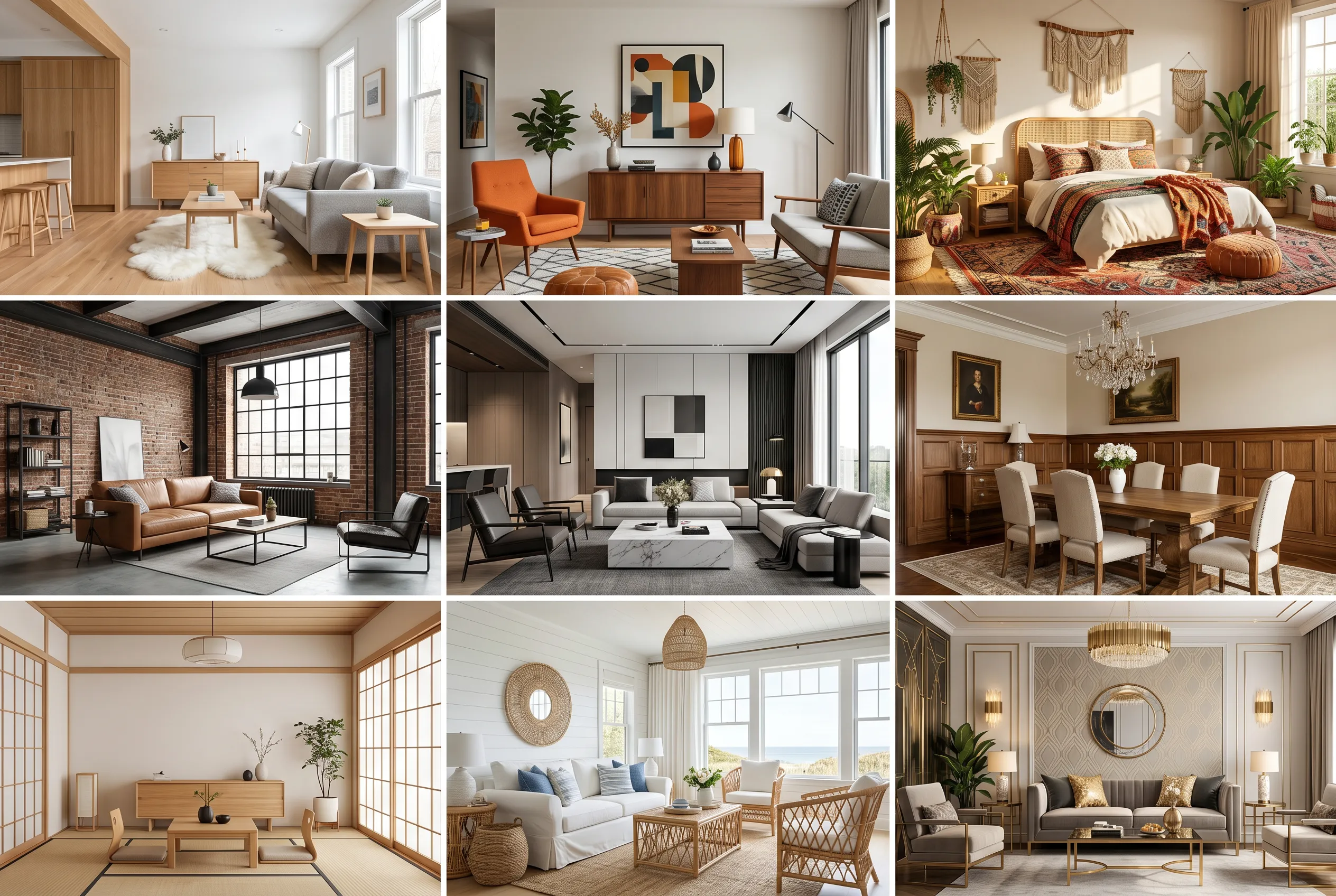
Most style labels get thrown around loosely. People call anything pale and uncluttered "Scandinavian" and anything with a velvet sofa "luxury." But each of these styles has a real lineage, a logic to its colors, and a set of materials that signal it at a glance. Knowing the difference is what lets you describe what you actually want, instead of saving fifty pins that quietly contradict each other.
This is a reference guide to the 19 styles InteriorLab supports, the same 19 you can apply to a photo of your own room in the app. For each one you get the short version: where it comes from, how to spot it, and the kind of person and space it tends to suit. Read it like a menu. The fastest way to know whether a style is right for your room is to see it on your room, which is the part AI handles in seconds.
The clean and current group: Modern, Contemporary, Minimalist
These three get mixed up constantly, and the distinction matters. Modern is a specific historical movement, roughly 1920s to 1950s, born from the Bauhaus and the idea that form follows function. It means clean horizontal lines, unornamented surfaces, and a restrained palette of black, white, and natural wood. Contemporary, by contrast, just means "of right now." It borrows from current trends, so it shifts over time and tends to be softer and more comfortable than strict Modern, with curved edges and warmer neutrals.
Minimalist takes the same ethos further and strips it to the essentials. Empty space is treated as a material in its own right. A minimalist room often has one or two carefully chosen pieces, a monochrome or near-monochrome palette, and almost no visible clutter, which means real storage discipline behind the scenes.
- Modern suits people who like structure, symmetry, and a timeless look that does not chase trends.
- Contemporary suits anyone who wants something current and comfortable without committing to a strict rulebook.
- Minimalist suits people who find calm in empty surfaces and are willing to live with less.
The warm and natural group: Scandinavian, Japandi, Boho, Cozy
Scandinavian design came out of the long, dark Nordic winters, and it shows. The whole point is to pull as much light into a space as possible: white or pale gray walls, blond woods like ash and birch, and soft textiles layered for warmth. It is functional and democratic by tradition, shaped by mid-century Danish and Swedish designers who believed good design should be affordable. Japandi is the hybrid that emerged when that Scandinavian warmth met Japanese restraint. Think low furniture, muted earth tones, handmade ceramics, and a deliberate sense of quiet.
Boho, short for bohemian, runs in the opposite direction. It is layered, collected, and personal, built from rattan, macrame, plants, patterned textiles, and pieces that look gathered from travels rather than bought as a set. Cozy is less a strict style than a goal, closely tied to the Danish idea of hygge: warm lighting, soft throws, deep seating, and textures you want to touch. It often borrows from Scandinavian and rustic looks but prioritizes comfort over any single aesthetic rule.
- Scandinavian suits small or low-light apartments and anyone who wants bright, practical, and uncluttered.
- Japandi suits people drawn to calm and craft who find pure minimalism a little cold.
- Boho suits collectors, plant lovers, and anyone who wants a room that feels personal and unforced.
- Cozy suits people who care more about how a room feels at night than how it photographs.
The character and craft group: Mid-Century Modern, Industrial, Farmhouse, Rustic
Mid-Century Modern is the postwar style that never really left, popularized by designers like Charles and Ray Eames, George Nelson, and Hans Wegner. You recognize it by tapered wooden legs, organic curves, walnut and teak, and accent colors like mustard, olive, and burnt orange against clean lines. Industrial pulls its look from converted factories and lofts: exposed brick, visible ductwork and pipes, raw concrete, blackened steel, and reclaimed wood. The palette is gray, black, and rust, and nothing is hidden that could be left honestly bare.
Farmhouse and Rustic both lean on natural, weathered materials, but they are not the same. Modern farmhouse is crisp and largely white, with shiplap walls, apron-front sinks, black hardware, and a tidy, fresh feel. Rustic is rougher and warmer, built on rough-hewn timber, stone, exposed beams, and a deliberately unrefined, lodge-like quality. Where farmhouse cleans things up, rustic leaves the texture in.
- Mid-Century Modern suits people who want warmth and personality without giving up clean lines.
- Industrial suits lofts, open-plan spaces, and anyone who likes raw materials and an unfinished edge.
- Farmhouse suits those who want cozy and welcoming but still bright and orderly.
- Rustic suits cabins, country homes, and anyone drawn to heavy timber and natural texture.
The classic and elevated group: Traditional, Transitional, Luxury, Art Deco
Traditional design draws on 18th and 19th century European interiors: symmetry, dark woods like mahogany and cherry, rich fabrics, detailed moldings, and antiques or antique-inspired pieces. It values order, history, and a sense of permanence. Transitional is the bridge between traditional and contemporary, and it is one of the most popular choices for a reason. It keeps the comfortable proportions and quality of traditional furniture but drops the fussy ornament, landing on a neutral, calm, broadly appealing middle ground.
Luxury is defined less by a single look than by materials and restraint at scale: marble, brass, velvet, statement lighting, and generous proportions, all kept intentional rather than crowded. Art Deco is more specific and more dramatic, born in 1920s Paris. It runs on bold geometry, symmetry, high-contrast color, and glamorous materials like lacquer, gold, mirror, and exotic veneers. Fan shapes, sunbursts, and stepped forms are its signatures.
- Traditional suits people who love symmetry, heritage, and rooms that feel established.
- Transitional suits couples or households that want classic comfort without it reading as old-fashioned.
- Luxury suits larger spaces and anyone who wants richness through materials rather than clutter.
- Art Deco suits the bold, who want glamour, contrast, and a sense of theater.
The relaxed, sunlit, and bold group: Coastal, Mediterranean, Maximalist, Eclectic
Coastal is built around light and the sea. It uses whites, soft blues, and sandy neutrals, natural fibers like jute and linen, weathered or whitewashed wood, and an airy, breezy feel that should never tip into a literal seashell-and-anchor theme. Mediterranean shares the warm-weather ease but trades the cool blue palette for terracotta, ochre, and olive, with stucco walls, arched doorways, wrought iron, and patterned tile drawn from Spanish, Italian, and Greek tradition.
Maximalist and Eclectic both reject restraint, but with different logic. Maximalism is deliberate abundance: layered patterns, saturated color, gallery walls, and the confident idea that more can be more when it is intentional. Eclectic is about mixing styles and eras on purpose, pulling a mid-century chair, an antique rug, and a modern light into one room and making them agree through a shared palette or a repeated material. Done well, eclectic looks collected; done carelessly, it just looks like a room that has not decided.
- Coastal suits bright homes and anyone who wants relaxed and airy without a literal beach theme.
- Mediterranean suits sunny climates and people drawn to warm earth tones and handcrafted texture.
- Maximalist suits confident decorators who feel starved by empty walls.
- Eclectic suits collectors with a strong eye who want their own mix, not a showroom set.
How to test a style on your actual room
Reading about a style only gets you so far. The same Scandinavian palette that looks bright in a north-facing studio can feel flat in a room with heavy afternoon sun, and a maximalist scheme that works in a tall Victorian can overwhelm a low-ceilinged flat. The variable that matters most is your specific room: its light, its proportions, and the things you already own.
That is the part AI shortens from weeks to seconds. In InteriorLab you snap a photo of the room, or LiDAR-scan it on a supported iPhone, and apply any of these 19 styles to see your space redesigned. From there you can edit individual pieces, swap a sofa, recolor a wall, or remove an object with Magic Erase, and compare the before and after side by side. Many of the pieces in a result link to real products through Shop the Room, and Furniture Fit lets you preview a specific item in your room in AR before you buy it. The point is to try three or four styles on the actual space and let the room tell you which one it wants.
Frequently asked questions
What is the difference between Modern and Contemporary?
Modern refers to a specific design movement from roughly the 1920s to 1950s, with clean lines, function-first forms, and a restrained palette. Contemporary simply means current, so it follows present-day trends and tends to be softer, warmer, and more comfortable. Modern is fixed in history; contemporary keeps changing.
Which interior design style is the most popular right now?
Transitional and Japandi are both having a long moment because they blend comfort with restraint and avoid looking dated. Scandinavian remains a default for smaller and lower-light homes. That said, popularity matters far less than fit. The best style for you is the one that works with your room's light, size, and the pieces you already own.
Can I mix two interior design styles in one room?
Yes, and the eclectic style is built entirely around doing exactly that. The trick is to give mixed pieces something in common, usually a shared color palette or a repeated material, so the room reads as collected rather than random. Two styles is plenty; beyond that, rooms tend to lose their thread.
How does InteriorLab show me a style on my own room?
You take a photo of the room or LiDAR-scan it on a supported iPhone, then choose any of the 19 styles and the AI redesigns your space in seconds. You can edit specific items, compare the before and after, and preview real furniture in AR before buying. Trying a few styles on your actual room is the quickest way to know which one fits.